Origins and first advances in animation
The animation it has its roots in the 19th century, when optical devices were created that generated the illusion of movement through sequential images. These inventions were fundamental for future development.
Experiments with devices such as the thaumatrope, zootrope and praxinoscope marked a before and after, preparing the ground for the first animated visual works that would surprise the world in the following decades.
Optical inventions of the 19th century
In the 19th century several emerged optical artifacts that achieved movement effects from still images. These devices fascinated the public by showing the illusion of life.
The thaumatrope, the zootrope and later the praxinoscope were the pioneers in this technique that consisted of a rapid succession of images. These inventions are key in the history of animation.
These methods were based on retinal persistence, a visual phenomenon that made possible the perception of continuity in animation, laying the foundations for cinema and animation as we know it.
First animated short films
The first animated short film recognized was “Humorous Phases of Funny Faces” (1906), created by James Stuart Blackton, who used drawings to tell a simple but innovative story.
In 1908, Émile Cohl presented “Fantasmagorie”, considered the first animated short screened in a cinema, with a linear and surreal drawing style that surprised viewers.
Winsor McCay integrated traditional animation with real filming in “Gertie the dinosaur” (1914), taking a step forward in the interaction between animation and the real world.
Innovations and consolidation in the 20th century
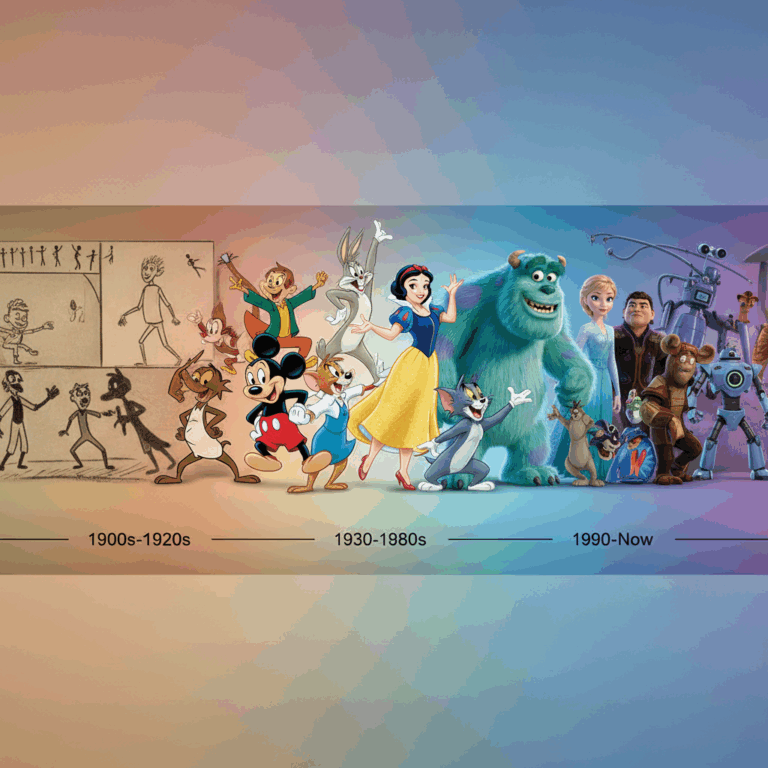
The 20th century was crucial for the animation, with technical and narrative advances that established the foundations of the medium. Feature films were created and techniques were developed that revolutionized the industry.
From color short films to television series, animation has established itself as a global art and industry, opening paths for future innovations and commercial and creative successes.
Classic animation and pioneering feature films
During the 1930s, Walt Disney marked a milestone with “Snow White and the Seven Dwarfs” (1937), the first color and sound animated feature film, which elevated animation to a complete art form.
In addition, techniques such as rotoscope, which allowed more realistic movements, and the incorporation of color enriched the stories and characters, increasing the visual impact.
In parallel, Quirino Cristiani made history in Argentina with “El Apóstol” (1917), the world's first animated feature film, although unfortunately it has been lost, his legacy is fundamental for animation.
International expansion and serial animation
After World War II, animation expanded globally. Japan stood out with Osamu Tezuka, who created anime, a style with greater fluidity and characterized by its artistic originality.
In the United States, television popularized serial animation with series such as “The Flintstones (1960), which brought animation to millions of homes and established a renewed format for the industry.
This expansion allowed the diversification of styles and formats, promoting greater variety and experimentation in animated content internationally.
Technical and artistic experiments
The last decades of the 20th century saw important experiments in animation, combining traditional techniques with technical and artistic innovations that expanded creative possibilities.
Studios and artists tried different styles and technologies, exploring everything from stop motion to new forms of visual storytelling to enrich the viewer's experience.
The arrival of CGI in the mid-90s marked a radical change, but classical techniques continued to coexist and adapt, showing the richness and diversity of animation.
Digital evolution and new technologies
The appearance of the computer animation it revolutionized the industry, ushering in a new, more sophisticated and versatile era in visual creation. CGI was rapidly consolidated.
Technological advances made it possible to create worlds and characters with great realism and complexity, expanding the narrative and visual possibilities that animation could previously offer.
Computer animation and CGI
In 1995, Pixar's “Toy Story” became the first fully computer-generated feature film, opening the doors to 3D animation and new digital techniques for film and television.
Since then, CGI has become a standard for both film and television productions, allowing visual effects never before seen or imagined in animation.
This technology makes it easier to create characters with more natural movements, detailed environments and special effects that enrich the audience's visual experience.
Coexistence of traditional and digital techniques
Despite the rise of CGI, traditional techniques such as hand drawing and stop motion continue to be valued and are integrated with digital methods, creating hybrid works that combine both worlds.
The use of digital tools has made it possible to revitalize classic techniques, improving quality and efficiency without losing the aesthetics and original charm of traditional animation.
This coexistence enriches creative diversity, offering artists multiple resources to tell unique stories and experiment with different visual styles.
Current and future perspectives
The mixed techniques they combine traditional animation, digital and augmented reality, opening new avenues for creation and interaction with the viewer. This enriches the visual narrative.
The interactivity it has become a key element, allowing the public to influence the history and development of animation, especially in video games and digital platforms.
Mixed techniques and interactivity
The integration of mixed techniques it allows you to create hybrid works that combine drawing, 3D modeling and visual effects in real time, improving the immersive user experience.
Interactivity in animations fosters a direct connection with the audience, integrating virtual and augmented reality elements that offer active and personalized participation.
These innovations expand creative and narrative possibilities, adapting animation to the current and future technological and cultural demands of viewers.
Global impact and creativity in animation
Animation today is a global phenomenon that influences all cultures, promoting diversity and artistic experimentation through universally accessible digital platforms.
Creativity has diversified, with independent artists and large studios exploring new styles, genres and themes that reflect a more connected and complex society.
This global impact fosters cultural exchange, promoting innovative stories that challenge traditional boundaries and reinforce the importance of animation as an expressive medium.