Emerging technologies in animation
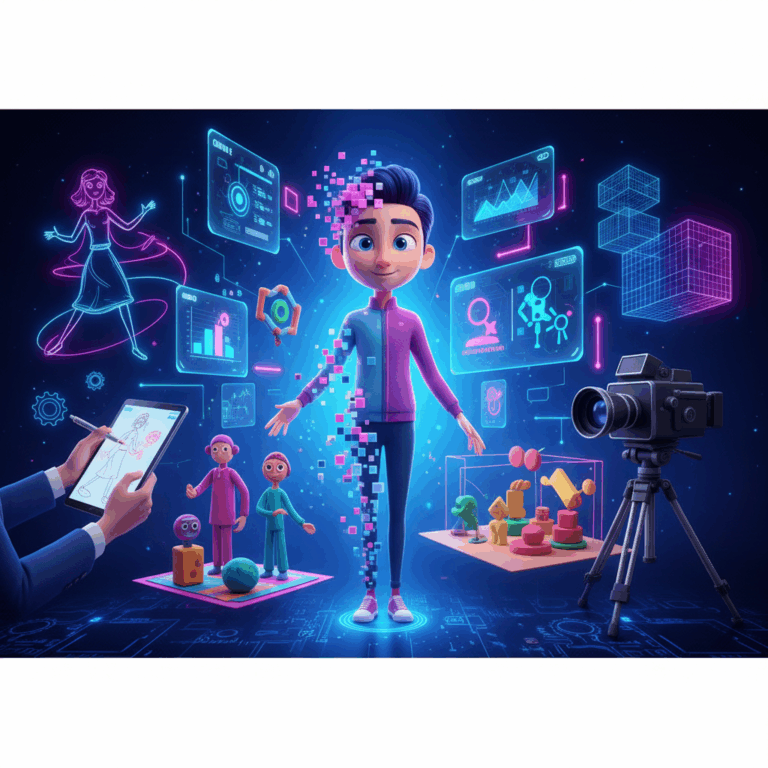
Animation in 2025 is marked by technological innovations that redefine production and visual style. The combination of techniques is transforming the sector.
The new tools enhance creativity by automating processes, leaving animators to focus on narrative and the aesthetic exploration of their works.
Use of artificial intelligence in production
The artificial intelligence it revolutionizes animation, facilitating tasks such as rotoscoping, lip-sync and sequence generation using AI, optimizing time and resources.
This automation frees creators to focus on creativity, expanding expressive possibilities by enabling new narrative and visual approaches.
Tools like RunwayML and Stable Video Diffusion are at the forefront, showing the potential to generate animations from textual descriptions or images.
Mix of 2D and 3D animation
The trend towards fusion of 2D and 3D animation create a hybrid style that enriches productions, combining visual clarity and spatial depth.
This mix provides originality and aesthetic richness, making the animations more attractive and dynamic for both branding and storytelling.
Recent examples demonstrate how this combination elevates the visual experience by integrating flat elements with complex and expressive three-dimensional environments.
Trends in 3D animation and stop-motion
3D and stop-motion are in an exciting evolution, with technological advances that improve realism and expressiveness. These traditional techniques are enriched thanks to innovation and digitalization.
The combination of artificial intelligence and new tools allows for more detailed and complex productions, expanding the narrative and visual possibilities in these fields.
Advances in realism and details with AI
Artificial intelligence drives a significant increase in realism in 3D animation, simulating anatomical details and emotions with great precision.
Hyper-realistic rendering engines and motion capture collaborate with AI to create more natural and expressive characters and environments.
These advancements allow the animation to exhibit visual subtleties, increasing immersion and emotional connection with the audience.
Innovations in stop-motion and digitalization
Stop-motion is renewed with advanced software and digital techniques that improve frame-by-frame accuracy.
AI also optimizes post-production and effects integration, reducing costs and accelerating processes without losing the artisanal essence.
These innovations allow us to explore new aesthetics and styles in stop-motion, expanding their relevance in the current panorama.
Fun fact about stop-motion
Thanks to digitization, stop-motion can now be combined with 3D animation, creating unique visual hybrids that expand your creative language.
Integration of AR, VR and video games
The integration of augmented and virtual reality and video game elements is transforming 3D animation into interactive and immersive experiences.
These technologies allow users to actively participate in the narrative, exploring animated worlds from multiple perspectives.
The convergence of animation with AR, VR and gaming opens new avenues for creative expression and connection with broader audiences.
Tools and software that drive animation
Advances in tools and software are revolutionizing animation, allowing for faster and more efficient processes. Technological innovation is key to optimizing the creative flow.
These solutions make it easy to automate repetitive tasks, freeing up time for animators to focus on design and visual narrative.
Workflow automation and optimization
The automation using specialized software, it improves the workflow, streamlining stages such as rotoscoping, lip-sync and animated sequence management.
Tools like RunwayML integrate artificial intelligence to perform complex tasks quickly, reducing costs and enabling more agile production.
This digital optimization frees creators to focus their efforts on creativity, improving quality and allowing for more frequent iterations on their projects.
Future perspectives of the animation sector
The future of animation is characterized by convergence of techniques traditional and digital, creating increasingly immersive and interactive experiences.
The integration of 3D, stop-motion, AI and classic animation will open new possibilities for immersive narratives, where the viewer is an active part.
Convergence of techniques and immersive experience
Future animation will combine various techniques to achieve experiences immersive and personalized, integrating AR, VR and interactive elements.
This trend breaks boundaries between formats, offering audiences narratives where they can explore and participate, expanding creativity.
Hybrid projects mix artisanal with digital, breaking barriers between the viewer and the animated story, promoting total immersion.
Human role and procedural design in creativity
Although automation and AI are growing, the human role it remains essential, especially in artistic and conceptual direction.
The procedural design will allow you to create dynamic worlds and characters with less manual intervention, optimizing production without losing originality.
Creatives guide technological tools to achieve emotional and novel results, balancing efficiency and artistic expression.