Origins and historical influence of animation
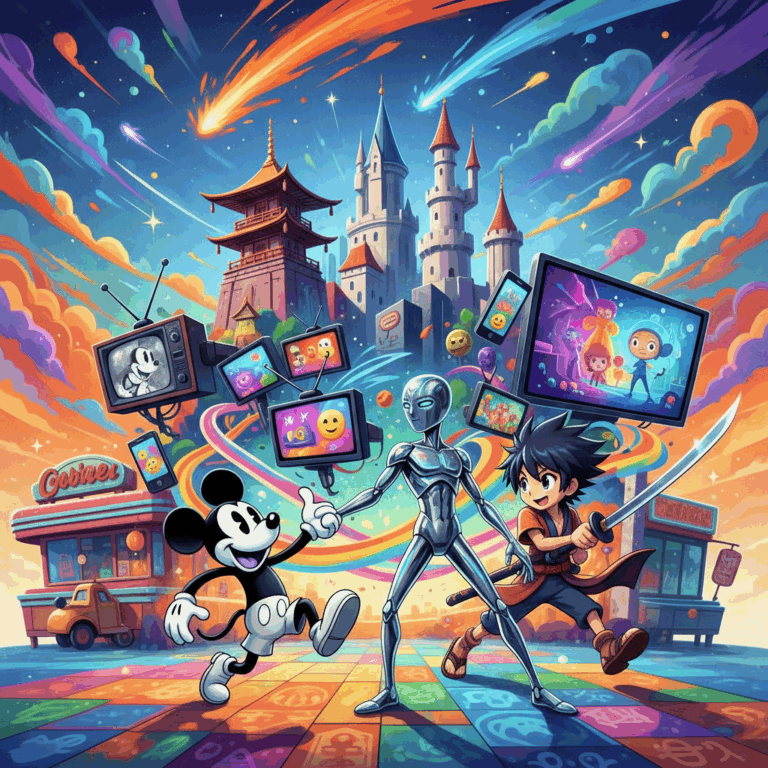
The animation its development began in the 19th century, marking a new path in visual narrative and in the way of telling stories. Its rise in the 20th century consolidated it as an art with great cultural impact.
This discipline has been transformed over time, going from simple moving drawings to complex audiovisual works that influence various cultures and generations.
Development and consolidation in the 19th and 20th centuries
Animation began as visual experiments in the 19th century, using primitive techniques that gave way to more elaborate forms in the 20th century.
With technological advances, animation became an artistic and cultural industry, giving life to countless characters and styles that marked an era.
During the 20th century, animation transcended its entertainment function to become a powerful means of communication and social expression.
Multiple disciplines involved in creating animations
Animation is the result of the fusion of various disciplines such as drawing, sculpture and computing, creating unique and attractive visual experiences.
Additionally, dramaturgy and music play a key role in bringing emotions and depth to animated narratives.
This interdisciplinary combination allows animation to transcend the graphic to become a universal cultural language.
Iconic characters and their cultural impact
The iconic characters animation has left an indelible mark on global culture, becoming recognized symbols that transcend generations.
These characters reflect social values and collective aspirations, establishing emotional connections that go beyond superficial entertainment.
Its influence extends to multiple areas, from fashion to language, shaping cultural identities and promoting intercultural exchange.
Universal symbols and their reflection of social values
Characters like Mickey Mouse or Pikachu are universal symbols that represent values such as friendship, courage and solidarity.
These characters act as social mirrors, showing the aspirations and challenges of different generations and cultures around the world.
By being recognized globally, they contribute to disseminating positive values and establishing behavioral models adapted to different social contexts.
Influence on fashion, language and the social imagination
Animation has significantly influenced the fashion, inspiring styles and trends with visual elements of popular characters.
Furthermore, expressions and language typical of these animated figures have been incorporated into everyday communication, enriching the social imagination.
This influence is reflected in pop culture, where animation acts as an engine of innovation and constant cultural renewal.
Intercultural connection through entertainment
Animated entertainment is a powerful tool that encourages intercultural connection being accessible and attractive to various audiences.
Characters and narratives from different cultures are shared and valued globally, facilitating understanding and empathy between communities.
This cultural interaction contributes to breaking down barriers and creating a global dialogue based on shared experiences through animation.
Anime and its global significance
The anime it has achieved global recognition, transcending its Japanese roots to influence diverse cultures and audiences. This has expanded its impact beyond entertainment.
Its global presence has fostered an interest in Japanese art, culture and traditions, creating an international community of followers passionate about its unique stories and aesthetics.
Influence of Studio Ghibli and promoted values
Studio Ghibli is iconic in the world of anime, recognized for promoting values such as ecology, empathy and courage through deep and emotional stories.
His works have inspired a reflection on nature and humanity, generating awareness and an appreciation for the environment in different generations.
Ghibli's impact surpasses traditional animation, establishing itself as a global cultural phenomenon that connects diverse communities through art and narrative.
Cultural and artistic manifestations derived from anime
The anime it has stimulated diverse cultural expressions, from cosplay and music to digital art and literature, creating a vibrant and diverse artistic ecosystem.
This influence is seen at international festivals, exhibitions and social networks where tribute is paid to its iconic characters and visual styles.
Interesting fact about the global influence of anime
Anime has inspired the creation of festivals and conventions that bring together thousands of people around the world, evidencing its power to unite diverse cultures through shared passion.
This cultural expansion constantly redefines the relationship between art, community and technology, promoting innovation and global artistic dialogue.
Innovation and education through animation
The animation it is a key tool for education, promoting inclusion and stimulating creativity, especially in young people.
Thanks to its diverse techniques, it allows content to be adapted in an accessible way, transforming learning into a more visual and understandable experience.
In addition, animation contributes to creating inclusive environments, where all students feel represented and motivated to express themselves.
Promotion of inclusion and creativity in young people
Animation facilitates the participation of young people with cultural diversity and different abilities, promoting inclusion in educational spaces.
By creating their own animations, young people develop creative and technical skills that strengthen their confidence and critical thinking.
This educational practice fosters collaboration, respect and appreciation for both cultural and personal diversity.
Importance in personal development
The process of animating encourages imagination, allowing young people to express emotions and values that they often cannot communicate verbally.
Thus, animation becomes a means for emotional and social growth, providing benefits beyond the academic field.
Innovative techniques and visual narrative evolution
Technologies such as digital animation, augmented reality and artificial intelligence have revolutionized the way we tell stories visually.
These tools allow you to create more dynamic, interactive and personalized narratives, which better capture the audience's attention.
The constant evolution of narrative techniques drives creators to explore new formats that better connect with contemporary audiences.